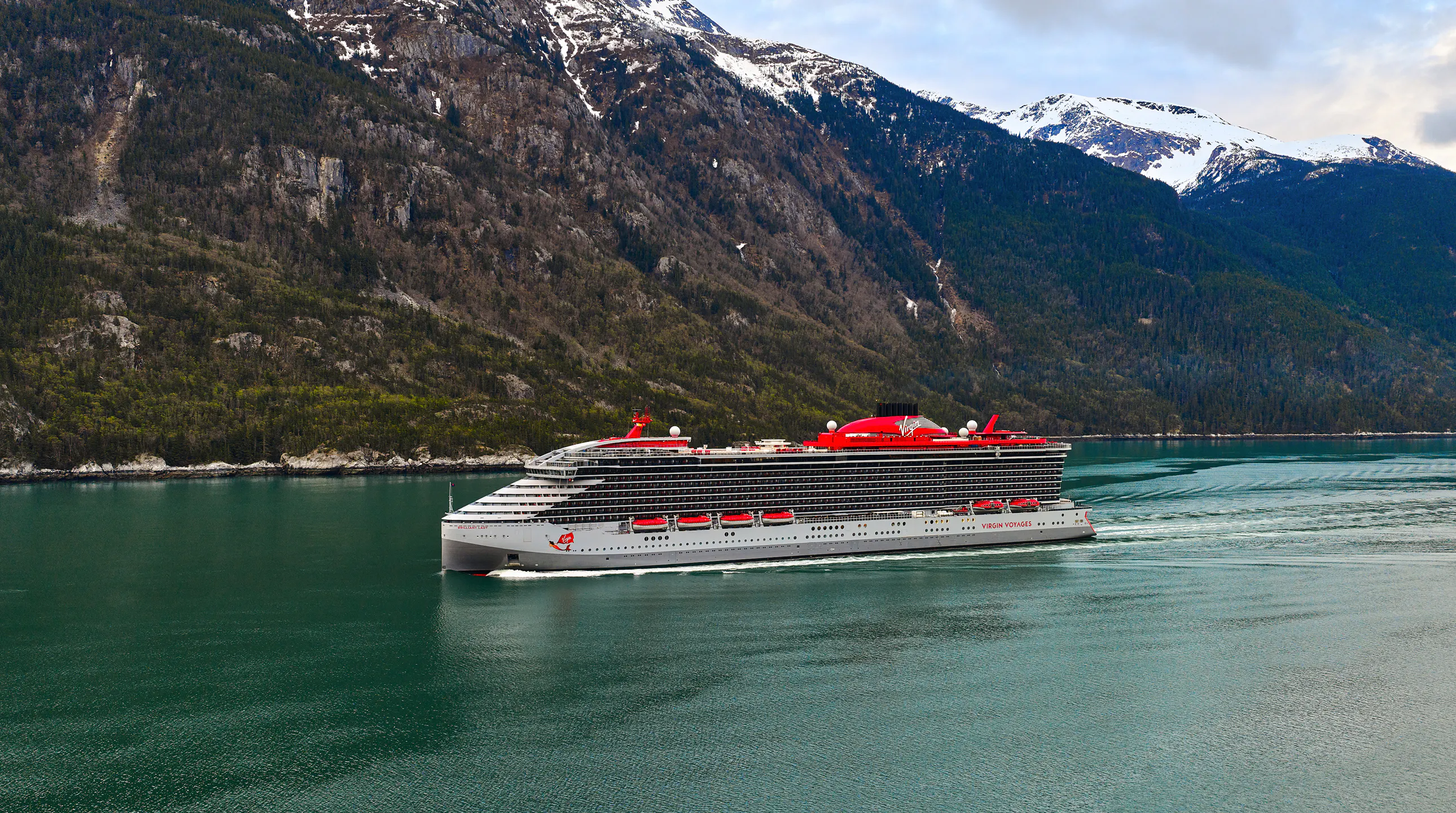
Watch Episode 6 first:
*By Billy Bohan Chinique, Vice President, Marketing & Digital Innovation
Watch this before reading — the whale-watching footage in particular deserves to be seen before I start info-dumping about fluke patterns at you.
Juneau is Alaska’s capital and one of its busiest cruise ports, and going in, I honestly assumed “busy” meant “less special” — the way a lot of heavily trafficked destinations can start to feel a little worn down by their own popularity. I was wrong about that, which by this point in the series should surprise absolutely nobody.
Michelle Bentubo, Chief Operations Officer at Virgin Voyages, has done this port more than ten times and told me Juneau is actually one of her favorite stops precisely because of how much flexibility it offers compared to some of the more tightly scheduled ports earlier in the itinerary.
An Easy Landing in a Busy Port
For Brilliant Lady, Juneau is a tender call rather than a direct dock, meaning we took a short boat ride — roughly 10 to 12 minutes — from ship to shore. I was curious how that would feel compared to the more dramatic port approaches earlier in the series, and the answer is: refreshingly easy. It’s a quick, low-friction way into a historic downtown packed with shopping and eateries, including our own lunch stop at Hangar on the Bay.
What You’ll See in This Episode
The first half of the episode centers on Mendenhall Glacier, which holds a distinction that genuinely surprised me: it’s the most accessible glacier in all of Alaska, sitting next to the first national-park visitor center ever built in the country. Unlike Hubbard, or the glaciers reached by helicopter in Skagway, Mendenhall doesn’t require any special transport — you can walk directly from the visitor center up toward the ice, with waterfalls and hiking trails along the way.
Jill, our sustainability lead who you’ll remember from Hubbard Glacier, used part of this segment for a quieter, more reflective moment around the Tlingit name for Mendenhall, which translates roughly to “the glacier behind the little lake.” That naming detail opens up a bigger question she wanted to sit with on camera: what happens to a place’s name, and the knowledge embedded in it, when the landscape itself changes faster than language can keep up?
The second half of the episode is the day’s genuine showstopper: the Exclusive Whales & Wine tour out on Saginaw Channel, where our guide Daniel and Captain Rob tracked down humpback whales and walked us through one of the more compelling conservation stories in the whole series.
Behind the Scenes: A Glacier You Don’t Need a Helicopter For
After spending an entire episode landing on a glacier by helicopter in Skagway, arriving at Mendenhall on foot felt almost anticlimactic at first — and then genuinely refreshing. Mendenhall’s accessibility is part of what makes it significant: it democratizes an experience that, everywhere else on this itinerary, requires a boat, a helicopter, or a fairly serious hike. Here, it’s a walk from a visitor center. Anyone can do this. That matters to me, and I think it should matter to you too.
There’s an interesting geographic footnote: Mendenhall sits across from Taku Lodge, meaning some tour operators reach the glacier area by boat, kayak, or even canoe rather than on foot — so even a single glacier offers wildly different modes of approach depending on which excursion you book. You can actually book that variety directly through Shore Things: a Canoe Paddle and Hike at Mendenhall Glacier, a Dog Sledding & Heli-Ride on the ice, or, for the fullest version of the experience, the Taku Lodge outing itself, which we’ll get to below.
The Real Story: A Species Brought Back From the Brink
The whale-watching segment on Saginaw Channel is where this episode does its most substantial work, and I didn’t want to treat it as a simple wildlife-spotting sequence. Juneau is the busiest whale-watching port in the United States, supporting more than seventy vessels across a single summer season — a number that only makes sense in the context of a genuine conservation success story.
Humpback whales in this region were hunted nearly to extinction during the commercial whaling era. They’re now back in the tens of thousands, a recovery that stands as one of the more concrete wins in modern marine conservation. Our guide Daniel, from Gastineau Guiding, explained something on camera I genuinely did not know: each whale’s fluke — the underside of its tail — carries a unique pigmentation pattern, functionally identical to a fingerprint. Researchers and guides use these patterns to identify and track individual whales over years, which means the animals surfacing next to your boat aren’t anonymous wildlife — they’re individuals with documented histories.
I want to sit with that for a second because it genuinely changed how I watch whale-watching footage now, including my own. That population recovery only holds up because Juneau’s whale-watching operators are held to strict operational rules designed to keep the animals safe — minimum approach distances, speed restrictions, protocols around how boats position themselves around active whales. With more than seventy vessels working the same waters every summer, that kind of self-imposed discipline across an entire industry is not a small thing, and I made sure to give it real airtime instead of reducing the segment to just footage of whales breaching.
The Science Behind Fluke Identification
I wanted to dig a little deeper here because it’s genuinely elegant field science that doesn’t always get explained well in tourist-facing contexts. Each humpback’s fluke carries a distinct pattern of black and white pigmentation on its underside, along with unique scarring and notch patterns along the trailing edge. Researchers have been photographing and cataloguing these patterns for decades, building identification databases that let scientists track individual whales’ movements, breeding patterns, and longevity across entire migratory populations.
That means when Daniel identifies a specific whale on camera during the Whales & Wine tour, he’s not guessing or improvising — he’s drawing on a body of field research that treats individual whales as trackable subjects with documented histories, not just anonymous wildlife. Part of what made this segment feel different from a typical whale-watching sequence to me: the animals surfacing next to the boat have names, in a sense, even if those names are catalog numbers in a research database rather than something poetic.
Shore Things Featured
Whales & Wine: A Tasteful Adventure Tour
The day’s showstopper: a small-group tour aboard a custom safari vessel out onto Saginaw Channel, led by a naturalist guide — Daniel from Gastineau Guiding on camera, with Captain Rob at the wheel — hunting humpbacks, and the morning delivers. Daniel explains that each whale’s fluke pigmentation is unique like a fingerprint, and that Juneau — the busiest whale-watching port in the US, with more than seventy vessels operating each summer — holds operators to strict rules that keep the animals safe. The “wine” half is a relaxed interlude featuring two glasses of wine and a salmon dip with crackers.
Good to know: runs about 3.75 hours total, roughly 2.5 hours on the water, in a small group. Accessible for collapsible wheelchairs provided Sailors can manage a few steps, since the boarding ramp can be steep depending on the tide. Includes two glasses of wine and light bites; 21+ to drink (photo ID required). Dress in warm, waterproof layers regardless of forecast.
Mendenhall Glacier (Self-Guided)
A self-guided visit to Alaska’s most accessible glacier — and unusually, no helicopter required. From the visitor center, the first-ever built for any US national park, you can walk directly up toward the ice, with waterfalls and hiking trails nearby. It sits across from Taku Lodge, so some tours reach it by boat, kayak, or even canoe.
For a guided version, several Mendenhall-focused Shore Things are available, including a Canoe Paddle and Hike at Mendenhall Glacier (5.5 hours), a Dog Sledding & Heli-Ride on Mendenhall Glacier (2.75 hours), and — if you want to go all in — Taku Lodge, one of Juneau’s top-tier Shore Things, plus more in the full Juneau Shore Things catalog.
Good to know: guided options range from a relaxed canoe-and-hike to a heli-assisted dog-sledding tour. Dress for rain regardless of which you choose.
Rookie vs. Ten-Timer: Juneau Edition
Michelle’s take on Juneau surprised me. As a ten-plus-timer, she said this is one of the few ports where she actually changes her plans nearly every visit, because the flexibility of a tender port with a self-guided glacier option means she rarely does the exact same day twice. Meanwhile, I, in full first-timer mode, wanted to lock down a rigid schedule the second we got off the tender. She talked me into leaving more open space in the day than I normally would, and it paid off — some of my favorite footage from this episode came from unplanned wandering through downtown Juneau between excursions.
Why Juneau’s Recovery Story Matters for the Rest of the Series
I placed real emphasis on the humpback recovery story in this episode because it offered something the rest of the series hadn’t fully addressed yet: a positive, ongoing conservation outcome rather than a static description of wildlife or landscape. Ketchikan’s crab fishery regulation and Hubbard Glacier’s climate nuance both touch on environmental stewardship, but Juneau’s whale population recovery is the most complete arc in the whole series — from near-extinction to tens of thousands, sustained by decades of active regulation across an entire commercial industry. It’s a reminder that the wildlife and landscapes on display throughout this itinerary aren’t preserved by accident — they’re the product of ongoing decisions that could just as easily have gone the other way.
Twenty Years of Selling Whale Watching Without Ever Doing It
Here’s an embarrassing admission for someone who’s spent two decades in this industry: I’ve written whale-watching excursion copy more times than I can count, and I had genuinely never been whale watching myself before this trip. Not once. I’d describe the feeling of seeing a humpback breach using secondhand adjectives pulled from other people’s trip reports, photo captions, and stock excursion descriptions. Standing on that boat with Daniel and Captain Rob, actually watching a whale surface close enough to hear it breathe, I realized how much of my professional vocabulary for this exact experience had been borrowed rather than earned. I don’t think I’ll write whale-watching copy the same way again.
Practical Tips for a Juneau Day Ashore
- Decide whether Mendenhall needs to be guided or self-directed. If you’re comfortable navigating on your own, the self-guided option is genuinely sufficient and frees up your day for Whales & Wine.
- Book Whales & Wine well ahead of your sailing date. The specific combination of a custom safari vessel, named naturalist guide, and wine pairing is more limited than generic whale-watching capacity citywide.
- Plan your downtown time around the tender schedule. Factor the roughly 10-to-12-minute ride each way into your timing.
- Book Taku Lodge well in advance if it interests you. It’s one of Juneau’s top-tier Shore Things, and capacity is limited.
- Pack a proper raincoat, not just a rain-resistant jacket. Locals mentioned this repeatedly during filming, and it’s advice I’d pass along without hesitation.
A Note on Why Juneau’s Story Felt Personal
I’ll admit something here: before this trip, my mental image of “whale watching” was basically a stock photo — a tail fluke against a gray sky, a boat full of people in matching rain jackets. I didn’t have a story attached to it, just an image. Daniel’s explanation of fluke identification gave me the story I didn’t know I was missing, and it’s changed how I think about wildlife tourism generally. It’s not just “go look at animals.” At its best, it’s an invitation into decades of actual field research and conservation work, if you’re willing to ask a guide one more question than you normally would.
Pro Tips From Me
- Skip the umbrella. Bring a raincoat. Locals will silently judge the umbrella, and they’ll be right to.
- If wildlife is your top priority for the whole voyage, this might be the port to splurge on the Exclusive tour rather than saving budget elsewhere.
- Grab lunch at Hangar on the Bay if your schedule allows — genuinely good, and it’s a nice midday reset between excursions.
- Ask your naturalist guide about fluke identification even if it’s not covered in the standard tour script — it’s the kind of detail that makes the whole experience click differently.
Catch you on the flip.
Ready to plan your own Alaska voyage? Explore Virgin Voyages Alaska itineraries.