In today’s post, we welcome special guest author Jeremy Larochelle, Virgin Voyages’ Head of Music, to tell you the story of our onboard music program.
It all starts with the name on our hull.
You see, the name on our hull is special. It’s the name of one of the greatest record labels of all time — a record label that rivals Sun, which brought us Elvis and rock and roll; Berry Gordy’s Motown; and Island Def Jam, which brought hip-hop to the masses.
All of those labels — and Virgin — did more than just introduce the world to new artists. They did it at key moments that changed popular culture…maybe even history.
Other cruise lines may have 500 piano bars; a thousand tribute acts; 5,000 fly-on entertainers. But the name on the hull is still not going to be the one that brought the world the Sex Pistols, the Spice Girls, the Human League, Boy George, Genesis, Peter Gabriel, Phil Collins, Janet Jackson, Paula Abdul…that list goes on and on and on.
That is a special name to carry.
But it goes deeper than that.
You see, that legacy on our hull is also the thing that gives spark to some deep-rooted values — not just at Virgin Voyages, but throughout the entire Virgin ecosystem.
An introduction to Virgin’s musical legacy
In 1977, it was all about soft rock.
And back then, record labels (especially the majors) had one goal: sell as many physical units (records) as possible, because there was a LOT of money in that. So much so, that labels worked closely (and sometimes nefariously) with radio to play certain music that could sell.
When one label found a sound that worked — something that got traction on radio — it became easier to sell more records. And with that, other labels followed that same style.
This is where we start to see eras take shape. We move from singles into album-oriented rock, into disco and pop. And in 1977, it was all about soft rock — or more specifically, a very folksy, post-hippie, well-produced soft rock.
I call it Laurel Canyon vibes.
And if you’ve been on our ships, you can actually hear echoes of this early in the morning in The Galley, at the Aquatic Club, and throughout the day in our passenger hallways and elevators. Or you can listen at home on our VV Spotify channel.
Back in ’77, all the record labels were chasing that same sound. And in Britain, there was a band that was anything but.
In fact, they were the polar opposite. Loud. Obnoxious. The kind of music that made your eardrums ring. They had already been kicked off one record label when they caught the attention of Richard Branson.
Richard wanted to sign them — this group that no one else wanted. And eventually, he got his shot.
After a now-infamous TV appearance in 1976, where they swore on air, their second label wanted out. Richard got the call — and he was more than happy to take it.
That band was signed to Virgin Records and released Never Mind the Bollocks, Here’s the Sex Pistols.
And in that moment — Virgin disrupts music.
The soft rock era was on its way out. Punk rock was on its way in.
But we didn’t just disrupt music, we disrupted popular culture as well. The hippie movement was on its way out, and angst was on. Torn clothing, Dr. Martens, open rebellion against any system. We didn’t just disrupt music. We disrupted popular culture.
At Virgin, we talk about disruption a lot. It’s a core part of who we are — not just at Virgin Voyages, but across the entire Virgin ecosystem.
We are the disruptors.
We wear it like a badge of honor. We are proud of it.
We move into industries to disrupt them.
We moved into the cruise industry to disrupt it.
And it’s kind of crazy when you think about it — that the spark for that core ideal comes from music.
The legacy of disruption continues
A few years later, the process repeats itself; there’s another band that none of the major record labels will touch.
The music is good. EMI even pays for their demos. But still, no one will sign them because they don’t fit the mold.
There’s a Black Brit on bass. A white Brit on guitar. And fronting the group is an openly gay Irish artist who prefers a cup of tea to sex. No other label wants that risk, but in steps Virgin with a mentality that we feel in the office, and I know our Sailors feel when they step on board our lady ships.
In our world, it doesn’t matter where you are from, what you look like, or who you love. You can float with Virgin.
And with that mentality, we sign Boy George and Culture Club.
And once again, we disrupt music.
Once again, we disrupt popular culture.
But this time, we do it through inclusion. Real inclusion, not the kind that shows up as a temporary logo change in February or June. Not the kind that lives on a corporate banner.
The authentic kind that our Sailors feel when they step onboard. Another value — directly tied to our music legacy. So the question becomes:
If you’re building a music program for Virgin Voyages, how do you take these ideas of disruption and inclusion and actually bring them to life?
How do you make a cruise ship music program feel like an indie record label like the one that helped spark it all?
Let me tell you a story about my first day at Virgin Voyages
I arrived at the Plantation, FL office with my suitcase, spent the morning filling out tax forms and watching HR videos — and at four o’clock, I was on a plane to Italy.
As the plane was landing, I remember looking out the window and seeing Scarlet Lady sitting in the shipyard. We hadn’t launched yet. That red hull was just shining — like a beacon of hope for something new in cruise.
When I arrived at Virgin Voyages, we were five days from launch.
The music program? Already built.
This was pre-COVID. A different world, musically speaking. The plan was to be heavily electronic. Four DJs. Five live musicians whose primary job was to play a show — and when they weren’t on stage, they’d break off and busk around the ship.
Having worked in the cruise industry for over a decade — and having sold talent to just about every cruise line — I knew this model far too well.
Someone shoreside picks the music. Sheet music gets created. Books get printed. And then you hire musicians who can read it and reproduce it.
But then something happened….an answer. Because music always leads the way — if you’re listening.
An artist-led onboard entertainment program
I walked into On the Rocks and saw one of our musicians, a piano player.
The room was dead. Empty. And he looked defeated, shoulders down, just going through the motions.
I sat down and listened to someone who was not enjoying his job in the least.
When I got the chance, I asked him, “Hey man, what are you playing?”
He said, “The book they gave me.”
I asked, “You don’t sound like you’re enjoying it.”
“I’m not,” he said. “This music doesn’t resonate with me. It’s not in my vocal range. I don’t even know most of it. It’s older than me.”
So I said, “Why don’t you play something you want to play?”
He starts playing Out of My System by Younger.
And almost instantly — everything changes.
His head lifts. He’s not hunched over anymore. He’s in it. Feeling it.
Within moments, someone sits down.
He leans in more. Gets creative. Starts playing with the arrangement. Even drops Richard Branson’s name into the lyrics.
Another person sits down.
Now he’s swaying. He’s grooving, he drops an F-bomb…that’s okay, no kids on board here.
And when he finishes…applause from a room that was dead just four minutes prior.
All because he was allowed to connect.
Through his instrument.
Through something he’s probably been perfecting his entire life.
While his friends were out playing tag, he was probably practicing. He has likely missed his fair share of school dances, parties, and just hanging out as a kid, so he could spend more time perfecting his instrument.
His whole life poured into this one thing.
And now, finally, he had the chance to share it. And in doing that — he lit up the room.
And just like that, we had our answer. This is how we disrupt the cruise industry. Not by controlling musicians with pre-approved books of music. Not by handing DJs laptops filled with tracks. But by building an environment where real artists — people who have devoted their lives to their craft — have the opportunity to connect through what they do best.
The goal was simple:
Give them great stages.
Give them incredible tech.
Give them a Crew experience like no other.
Surround them with other world-class musicians who lift each other up, challenge each other, and grow together.
The Manor at sea
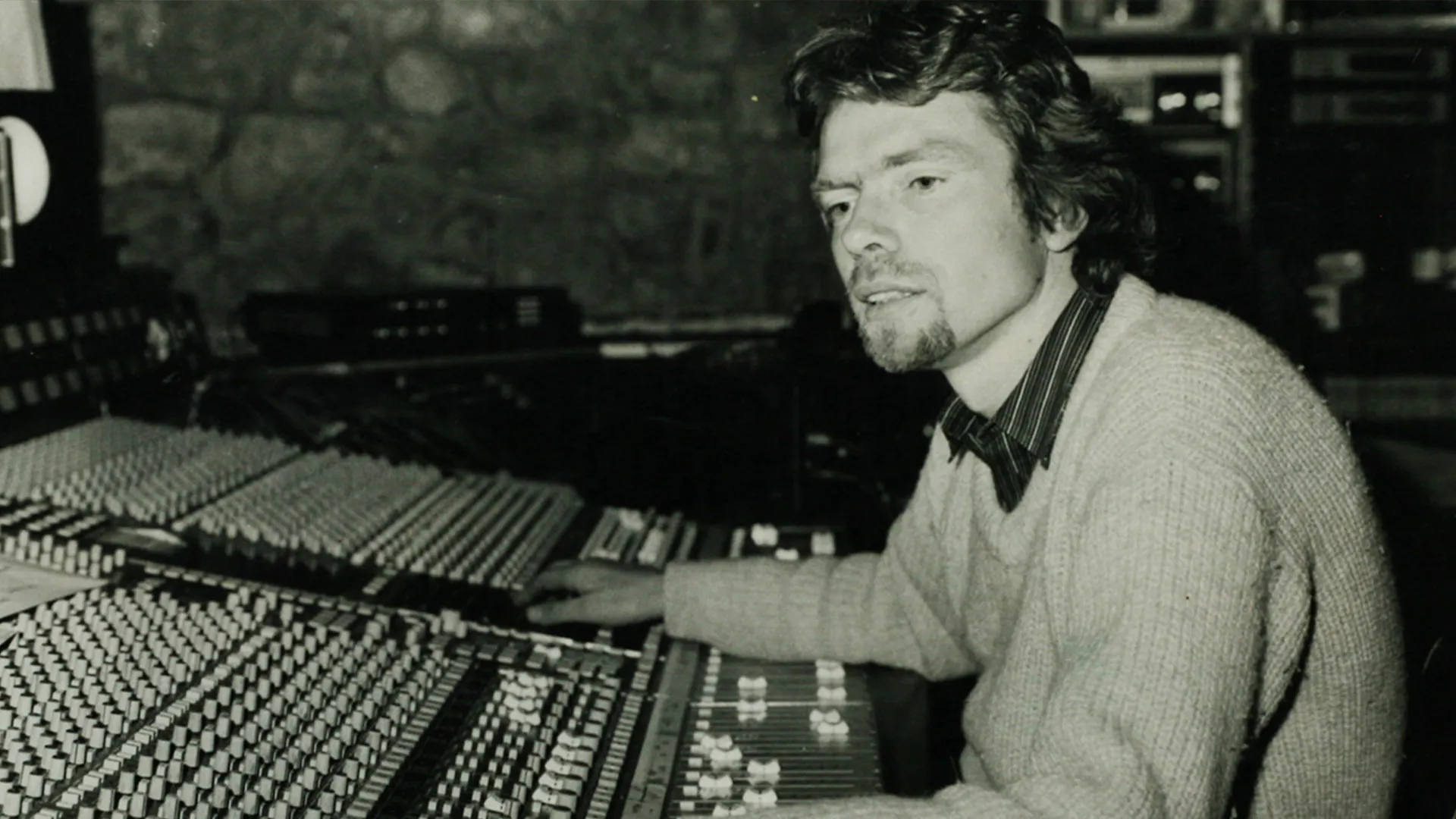
This wouldn’t be the first time a Virgin company leaned into music. And it definitely won’t be the last. You see, music has been charting the course for what Virgin would become for decades.
In the early ’70s, Richard Branson was visited by his cousin, Simon Draper. Simon was a rock journalist with golden ears. Richard trusted his taste so much that Simon began curating records to be sold out of the back of Student magazine.
When a postal strike hit and that model broke down, they pivoted and opened Virgin record shops, with Simon still curating.
Around that same time, a young engineer named Tom Newman had a problem.
His girlfriend gave him an ultimatum: “Get your recording gear out of our flat — or you’re both gone.”
Looking for somewhere to put his gear, Tom approached Richard with an idea: “You’re already selling records…what if you made them too? What if you built a recording studio?”
Richard was intrigued. He brought it to Simon and Nick.
Simon agreed — but with one condition:
If they were going to build a studio, it wouldn’t be like the others. Not sterile, rigid, controlled. A place where creativity could actually breathe.
So they found a property in Oxfordshire, England.
A place called The Manor.
And they built exactly what they set out to build — a bohemian creative community. Artists floated in and out. They recorded during the day, shot archery in the squash court, partied at night.
And just like our piano player…another young instrumentalist passed through. He had a demo and he gave it to Tom.
The pathway to one of Virgin's first signed artists
Now here’s where music starts doing what music always does — it leads.
When Tom was a child in the 1940s, he would come home to an empty house. It was his job to get things ready before his parents returned.
It was dark. He was afraid. So he’d put classical music on the gramophone. And those sounds made him feel safe.
When Tom played this demo, he heard that same feeling.
Familiar — but different. A little left of center. It pulled him in, so he took it to Simon.
Simon listened — and with those golden ears, he knew it was something.
They took it to Richard. And almost immediately, Richard agreed.
This would be one of the first artists signed to Virgin Records.
That artist was Mike Oldfield, and he went to work on what would become his opus: Tubular Bells.
There was just one problem: it wasn’t marketable.
Over 40 minutes long.
No vocals.
No clear single.
In the early ’70s, that was a death sentence.
No radio play.
No obvious path to sales.
But they believed in it.
They didn’t change it, or force it into a mold, or try to make it something it wasn’t.
They trusted the music.
Eventually, that belief paid off.
BBC tastemaker John Peel heard the album — and loved it so much, he played it in its entirety on air.
And just like that, it broke.
Records started selling.
Then music did what it always does: it traveled.
Across the Atlantic.
Into Hollywood.
Where a young filmmaker heard the opening of Tubular Bells — and knew it was perfect for his film. That film became The Exorcist.
And with that, Tubular Bells exploded.
An international success. To date, it's sold over 15 million copies worldwide.
Very few albums in history have done that. Virgin did it on their first try. More importantly, it gave the label something far more valuable than money: trust. Artists now knew that Virgin believed in the music first.
How Virgin Voyages’ onboard music program continues to honor artistic freedom
Virgin Voyages continues this music legacy by leaning into the creativity and professionalism of our musicians.
In their safe spaces — much like the environment created at The Manor — they’re free to create. But more importantly, they’re free to connect. And those connections with our Sailors are never the same twice. Each one is unique. Each one is real.
That’s part of how we carry this legacy forward at sea.
In future posts, we’ll dive deeper into how we also create a rich tapestry of musical genres, hits, and styles — on every single sailing.